Why this time can feel heavy
20 Nov – written by Katrin Kemmerzehl – Blog

With the beginning of the holiday season, warm lights are everywhere, shops are filled with decorations, and familiar songs play on repeat.
On social media, we see smiling families, festive gatherings, and perfectly lit trees. Many people genuinely look forward to this time of year.
But for others, the holidays carry a weight that isn’t always visible. While the whole world is celebrating, some people struggle quietly and experience sadness, loneliness, overwhelm, or anxiety.

Some are grieving loved ones, others are estranged from family, living alone, or simply feel out of step with the festive mood. Even for those who enjoy Christmas, expectations of joy might feel burdensome.
This season often magnifies whatever has been difficult throughout the year.
The contrast between how someone feels internally and how they think they’re supposed to appear externally can feel especially sharp, and that gap can be painful.
Yet joy and heaviness can sit side by side. In difficult seasons, small moments of warmth and tenderness still exist.
Why the holiday season can feel so hard

From the outside, it may look like everyone else is having a perfect Christmas, but there’s often emotional complexity underneath the surface:
Unrealistic expectations: The pressure to create the “perfect” holiday of hosting, cooking, decorating, buying thoughtful gifts, and feeling joyful can be exhausting.
Loneliness and isolation: Living alone, feeling disconnected, or experiencing strained relationships can be especially challenging around this time of year.
Financial pressures: The financial burdens of gifts, holiday events, food, and travel can add up.

Social expectations: Many also feel guilty for not doing “enough”, even when they do the best they can. Managing social events and expectations can be exhausting.
Family tensions: Even in families of love, old dynamics and unspoken resentments can arise. Many feel compelled to “keep the peace” and deal with complicated relationships.
Seasonal affective symptoms: Shorter days with less sunlight can affect our mood and energy on top of juggling everyday life and holiday stress (Melrose, 2015).
The quiet reality of loneliness
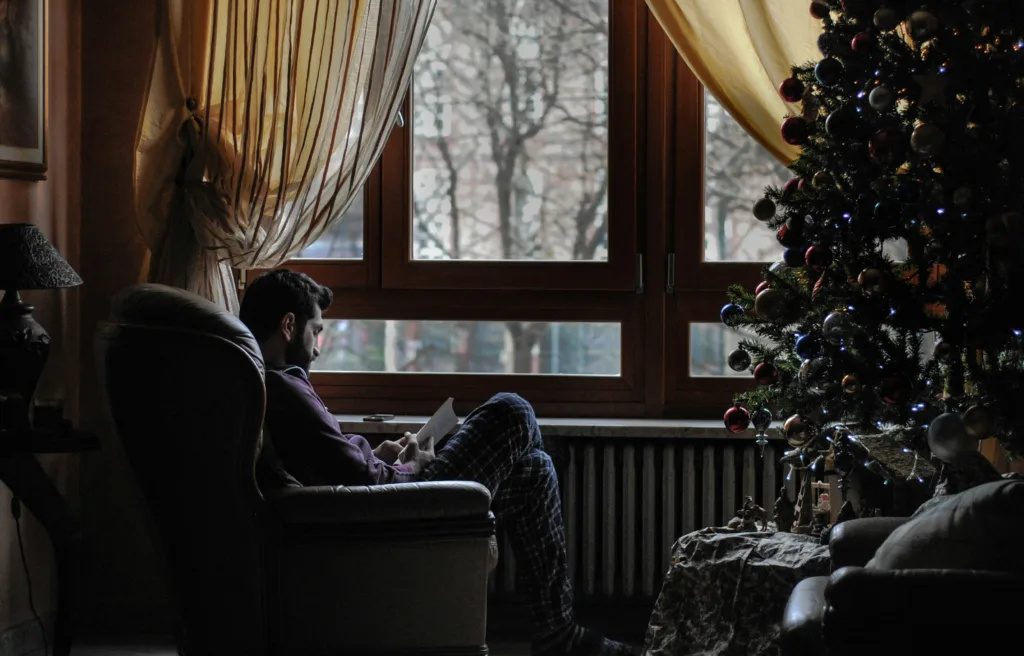
Experiencing loneliness during the holidays isn’t just limited to being alone. Many feel lonely even among others, especially if they feel misunderstood or disconnected.
Others may have chosen to put some distance between themselves and painful family dynamics.The quiet of the season can feel more intense for those who find themselves alone.

While we see big family tables and cosy gatherings on TV, a number of people spend the day in their homes with a pet, a book, or a simple meal. Likewise, spending the holidays with people you’d prefer to avoid comes with its own strain.
The beauty in solitude

Solitude also offers new opportunities. There can be comfort in space to breathe, rest, be yourself and make your own traditions.
Small rituals, e.g. lighting candles, watching a good film, taking a walk, or cooking up something nourishing, can bring moments of peace.
Even brief human contacts, such as a friendly chat or the smile of a passerby, can take the edge off loneliness (Hawkley & Cacioppo, 2010).
When family feels complicated

Holiday movies are filled with joyous family reunions, but in reality, families are often much more complicated. And often, the toughest part of the season isn’t being alone – it’s being together.
Old roles and unresolved hurts can quickly resurface. Fearing conflict can make us keep our distance, despite wanting connection.
Setting healthy boundaries

Healthy boundaries protect our internal world and are important for emotional wellbeing. They might look like this:
- determining how long you remain at an event
- going outside for air to take a break
- avoid triggering conversations
- opting out of difficult meetings
For some, having a plan in place, such as a grounding technique, a friend to text, or moments of quiet, can make family interactions more tolerable.
It’s ok to love your family and still find them difficult. You can have compassion for them and think about what you need.
The pressure to be merry

Many people remark on the pressure to appear happy at this time of year. In the context of anxiety, neurodiversity, grief, burnout, low mood or other challenges, feeling cheery, sociable or festive doesn’t always come naturally.
Thoughts may arise, such as: “Everyone else seems happy. What’s wrong with me?” or “I don’t have the energy for this.” Feeling down or overwhelmed doesn’t mean you’re failing; it means you’re human.
It may be helpful to remind yourself:
- What really matters to me this year?
- What can I let go of?
- What would make me feel better?
Sometimes, the simplest holidays are the most meaningful.
Gentle ways to find the light again

There is no quick fix for emotional pain, but small acts of care make a difference.
Moments of gratitude: A hot drink, relaxing on the sofa, or being in nature can lift our mood. Noticing small moments of gratitude in everyday life can improve our resilience.
Connect gently: For some, this means chatting with a friend. Others enjoy attending a community event or sharing some kindness with a neighbour. Even small acts of connection support wellbeing (Kuyken et al., 2010).
Move your body: Movement does not need to be intense, as gentle walks, stretching, or dancing in the kitchen can support mood and reduce stress.

Self-compassion: When thoughts such as “I should be happier” occur, stop to consider: What would I say to a friend feeling this way? Then offer yourself the same compassion (Neff, 2011).
Compare less: Social media shows curated photos. Too much scrolling can put us under pressure and invite comparison. Tuning into your needs instead can make the season feel more manageable.
Taking one moment at a time: The holidays can seem challenging when emotions feel big. Trying to stay in the here-and-now while simplifying one’s schedule can make things more manageable.
These small acts aren’t dramatic, but can have a calming effect on the nervous system and reduce overwhelm.
Self-compassion in the darker days

Many who struggle during the holidays judge themselves harshly, while telling themselves they “should cope better.” But emotions don’t follow seasonal expectations. Self-compassion is to approach oneself with care. It may appear as:
- “I’m doing the best I can” – taking a break when overwhelmed
- “I need to take care of myself” – letting go of unnecessary obligations
- “It’s ok to be sad” – acknowledge feelings without criticism
- “It’s okay to slow down” – resting without guilt
- “I deserve respect and kindness” – being with supportive company
Often, the light we’re looking for starts with how we speak to ourselves.
When to seek support

If the sadness seems to be persisting, or if you feel an emotional burden that is overwhelming, please know you don’t have to face it by yourself. Many report reaching out as the moment they finally allowed themselves to pause and breathe.
Counselling offers a confidential space to work through what feels heavy and find steadier emotional ground. A therapist can help you understand emotional patterns, process grief or relational stress, manage loneliness or seasonal low mood, develop coping strategies and more. Reaching out is a courageous form of self-care.
Light can still be found

The festive season can bring both light and shadow. Whatever feelings arise for you at this time of year, they are valid. Small moments of warmth can remind you that even in darker days, light can still be found. Be gentle on yourself this season.
And if you need support, therapy can offer a safe, compassionate space to begin finding your own light again.
If you’d like to explore this, please feel free to get in touch.
References
- Kuyken, W. (2010). Mindfulness-based cognitive therapy to prevent relapse in recurrent depression. Journal of Consulting and Clinical Psychology, 78(6), 841–855.
- Hawkley, L. C., & Cacioppo, J. T. (2010). Loneliness matters. Annals of Behavioral Medicine, 40(2), 218–227.
- Melrose, S. (2015). Seasonal affective disorder. Depression Research and Treatment, 2015, 178564.
- Neff, K. (2011). Self-compassion. HarperCollins.

Katrin Kemmerzehl
I’m a qualified counsellor based in Newcastle upon Tyne.
Please get in touch if you’d like to arrange a consultation.